Project
Koinonia
A web platform (PWA) for community and church leaders to follow people, attendance and care. Built with AI, directed by me. Published and in use.
- Status
- Live, in use
- Year
- 2026
- Role
- Product builder: problem, flow, AI directives, orchestration and testing
- Stack
- TanStack Start, React 19, Supabase, Tailwind CSS v4, Vitest
- Built with
- Lovable, Claude
- Tags
- Web, PWA, AI
About the project
The problem
Nobody notices who is drifting away.
Koinonia started at AWAKE, a network of young Christians. Leaders did almost everything from memory: who came to the meetings, who was missing, whose birthday it was, who to reach out to.
An attendance list records who came. It does not say where to start. The product exists to answer one question: who needs my attention today?
The product
A care queue, not an attendance list.
The Care Radar ranks each person by risk of drifting away, using recent attendance and time since the last meeting. That becomes an action queue: reach out, log the care given, follow up.
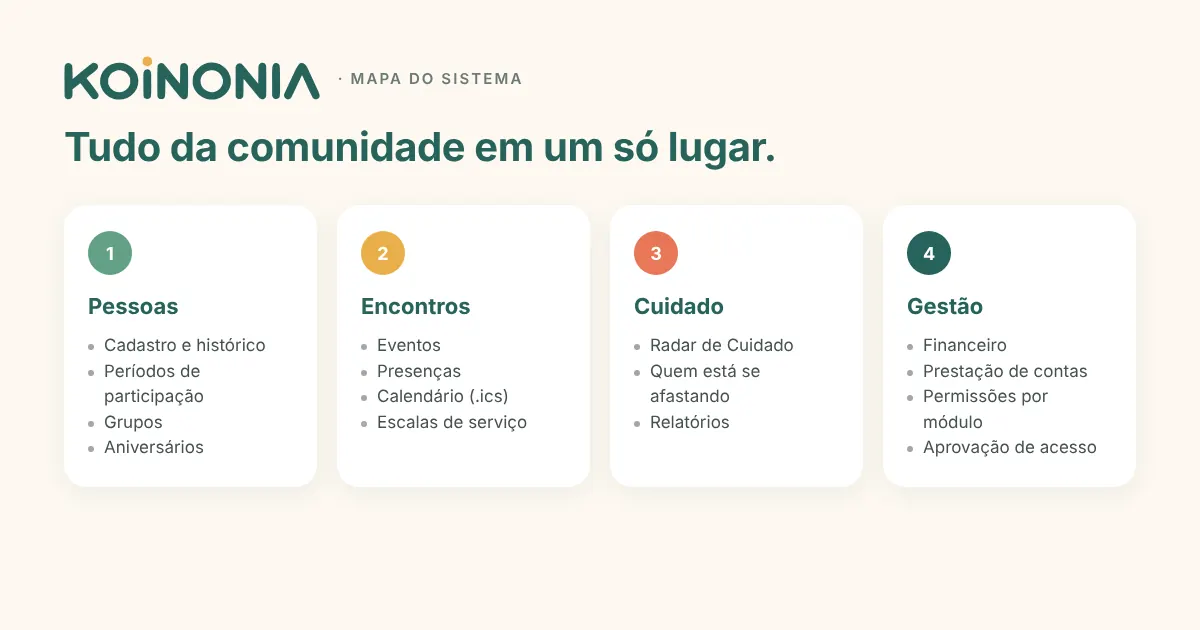
Newcomers aren't penalised: with fewer than three valid meetings, a person shows as “not enough history”, never as at risk. Around the Radar: quick roll call, birthdays, WhatsApp messages from templates, a calendar with rotas, small groups, finances and several isolated organisations on one platform.
Process and development
Current stage
Improve, step 5 of 5. Finished, live and in daily use.
Tap a step to see what it held for this project.
Improve
Iterative development · current step
- The September auditIt found the Radar failing silently past a thousand records and the 7-day filter comparing dates the wrong way. Both were fixed. Koinonia is live and in daily use.
How it was built
AI wrote the code. The direction was mine.
I didn't start in a code editor. I started with a brief for the AI, with one demand on the first page: no visual prototype. A real application the leaders could use.
From there, the work was direction: every round was a plan I wrote, the AI carried out, and I checked before the next one. AI shortened the distance between an idea and something testable. Deciding what to test stayed with me.
Define the problem
One question drives the product: who needs my attention today?
Design the flow
From the meeting's roll call to a care queue: attendance becomes priority.
Write the directives
An opening brief and dated evolution plans, written for the AI to carry out.
Orchestrate the build
521 commits between 16 August and 5 October 2026.
Test the result
Browser tests on desktop and mobile, and the product rules covered by automated tests.
What curation found
Working is not the same as being right.
In September 2026, what the AI had built went through a technical audit. The app opened, saved and looked right. The problems were where nobody looks in a demo.
The Radar would have failed silently.
Reads weren't paginated: past a thousand records, attendance, the Radar and reports would have gone wrong with no warning. Fixed.
The filter hid the people who needed it most.
“Contacted in the last 7 days” compared dates the wrong way round: any old contact counted as recent. Fixed.
No tests, no safety net.
No automated tests and 1,806 lint problems. Today the product rules are tested and checked continuously on GitHub.
Locked to the AI editor.
Build, logo and telemetry depended on the tool the app was born in. The project moved to its own repository and configuration.
What I learned
I learned where the tool ends.
I started Koinonia with Lovable, but quickly ran into the tool's limits. I moved development to Claude, where I had fewer restrictions and more room to create.
Along the way I had to learn, hands-on, how to make design decisions, implement payment integrations and run rigorous validation. The AI wrote the code, but my curation and continuous learning are what made sure the product actually worked.